Bobbing Through The Mountains, Chewing Birch Leaves
The editors reflect on their recent trips to Wester Ross
Nasim: Greetings from my favourite season: the grassiest, the leafiest, the brightest, and hopefully facing onto the warmest.
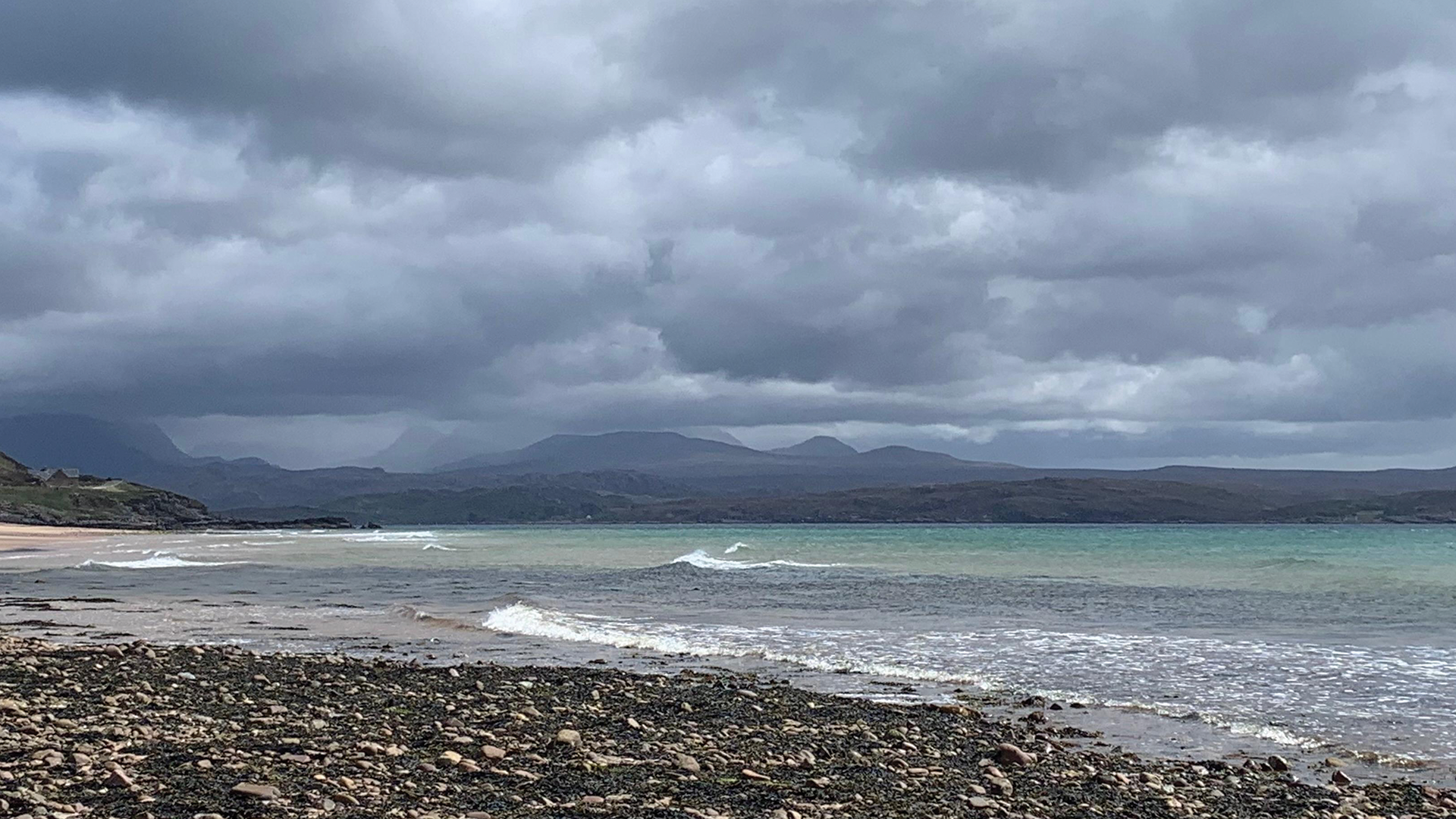
Last week, after sourcing some recommended spots from Patrick, my partner and I embarked on our first ever hired-van adventure five hours north. On our way up, we counted the rain and hail: there were thirteen rains and three hailstorms. One, particularly strong, hit us in Inverness as we were eating our fish & chips in a shipping container by the dark sea, together with a family on their way home from a funeral. We huddled together as the ice pelleted. There were a few rainbows that day, too, and a relentless number of them on our way back down two days later. By then, our counting phase was over. We were busy taking turns to play our teenage tunes and full to the brim with every kind of weather.
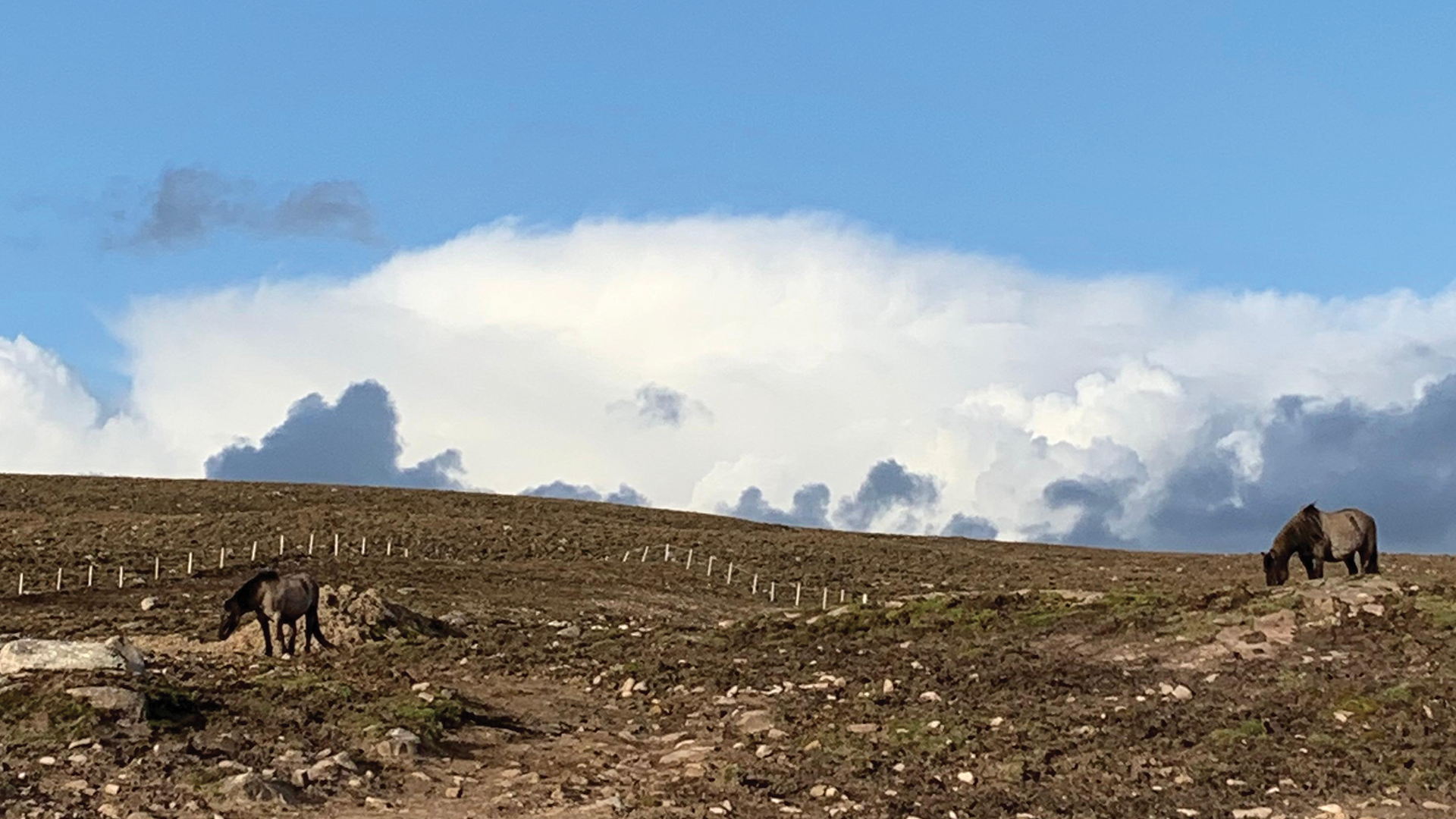
Driving through Torridon, I spotted a mountain that drew me in, at first inexplicably. Then, it began to look snakelike in its patterning, its coat and the shape of the ridge expressing part of a personality, and some set of elements that my visceral self found magnetic, both attractive and repellant. It was in this sense that it most resembled a snake, making me wonder about the character we imbue the world with and the character with which it is actually imbued; a wondering with no end.
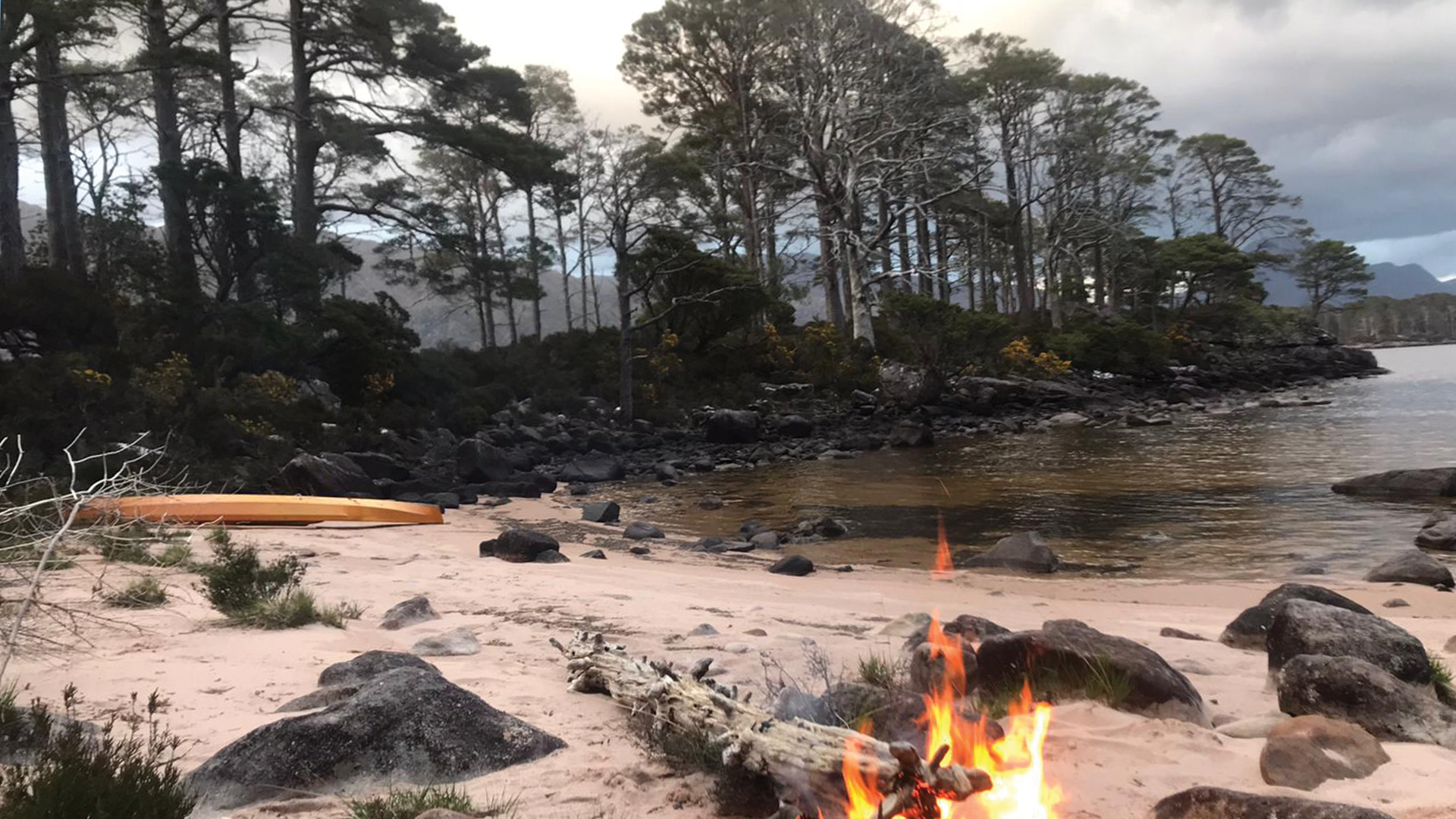
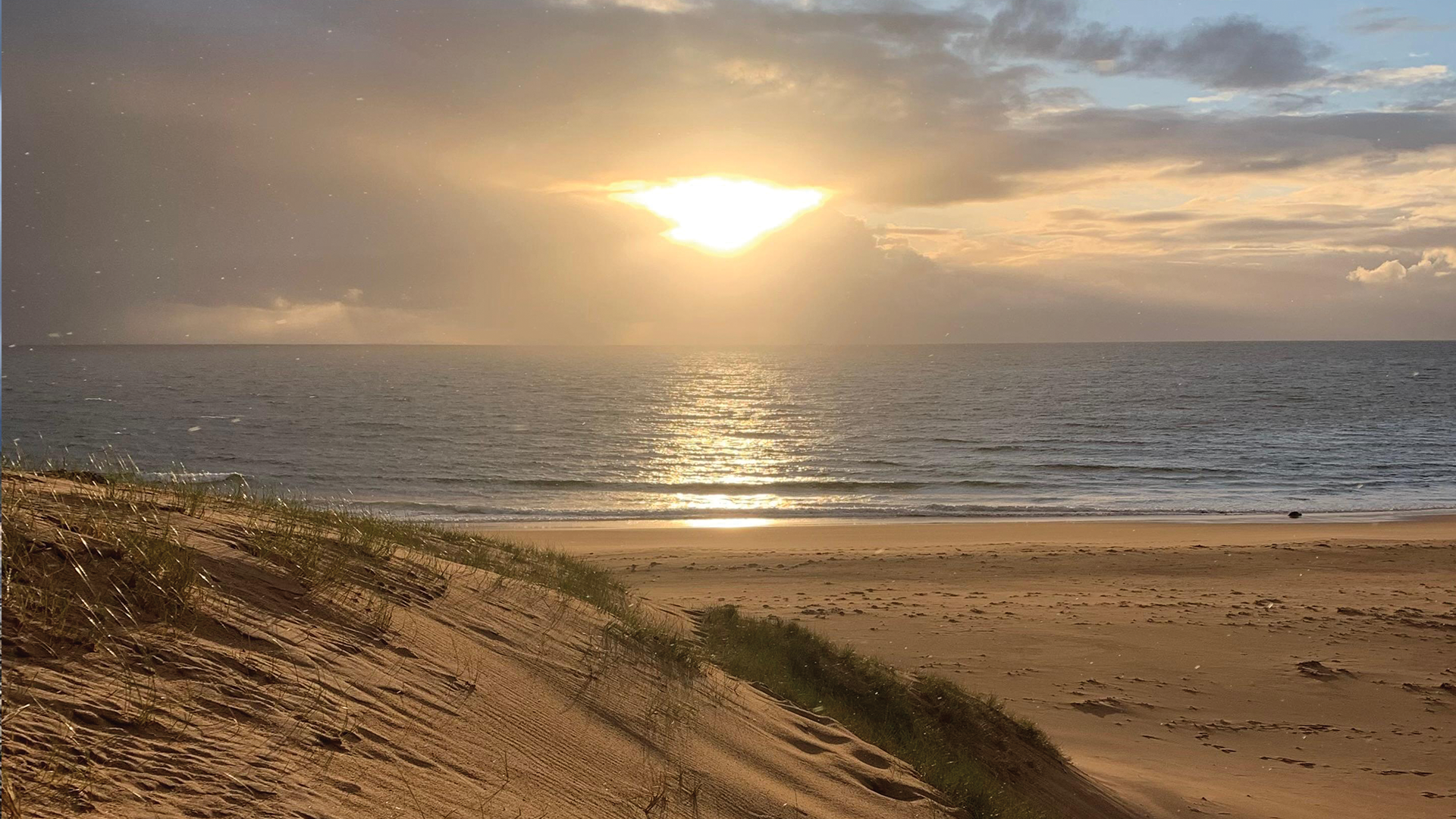
We lit a fire on the beach, on top of a Saharan pink dune, facing the sea and the ever-shifting clouds, translating them into time in safety. At some point, we almost ran off, not wanting to get soaked, but luckily we’d found ourselves at the edge of the cloud’s firing range. Then we slept very comfortably on a futon up the hill, in a windowless can at a gorgeous viewpoint. The wind was strong at all times, threatening to blow over the van. The following night was much calmer, spent on the shores of Loch Rannoch, where we found a tree many must have slept under. Its roots formed a perfect ceiling, a shelter from what had threatened us so the day before. Instead of brushing our teeth, we chewed birch leaves.
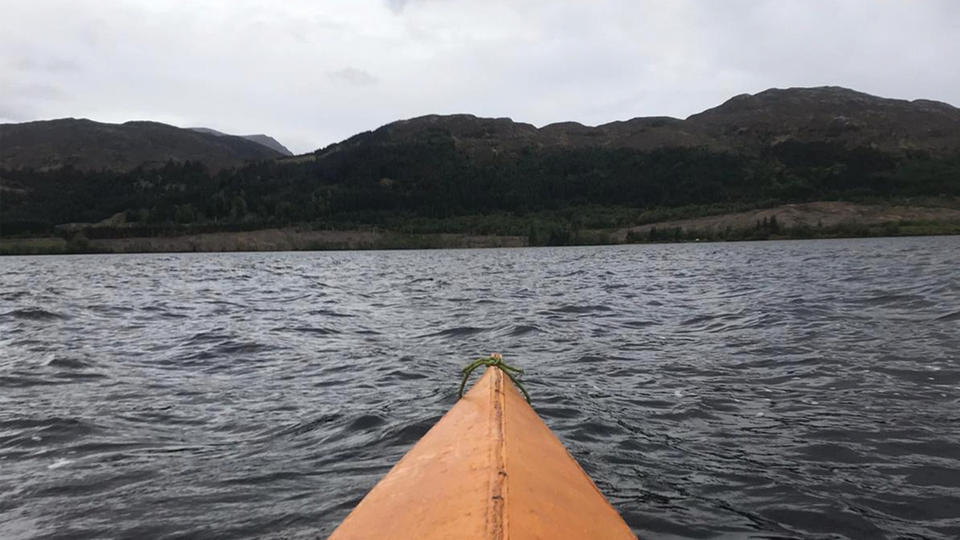
Patrick: A couple of days later, somewhere on the other side that snake-like hill (Beinn Eighe maybe, in which case one with three prongs in its tongue) I found myself paddling between the islands of Loch Maree, home to some of Scotland’s last ancient pine woodland, a Celtic saint’s hermitage, the ruined walls of a renaissance garden, and an island within an island within an island. Setting out, I had found a spinner snagged on weeds in the shallows, a rusty brass beetle with blue marks and a hook whose fishing days were long gone. Midway across, I unfastened it from my buoyancy aid and let it drop over the side, watched it vanish, then gazed at the hypnotic ripple it made on the flat, calm water. A talismán found, a talisman returned.
Not far away, sitting in my kayak’s yellow twin, the friend I was with was experiencing vertigo. Used to the chop and rock of the sea, the honeyed surface made him feel very high up. We sat about three hundred metres from either bank with what felt like infinite loch beneath us, a cuckoo calling, and tried to differentiate the Torridon massifs: Liatach, Beinn Eighe, and Beinn Alligan, whose Horns were tucked away. I don’t know if it got rid of his dizziness but it gladdened me as we sought out the softest landing below Slioch (a beach on the Letterewe Estate, owned by Clyde Properties NV, registered in the tax haven of Curacao). On a recent winter visit to those hills, my brother hauled me over the fuselage of a bomber in the ice. Hanging on a frozen rope, the vertigo on that ascent came with the shock at how a gully can feel enclosed and exposed at the same time. I’d never heard of that response to water but it made me feel sympathetic toward my spinner falling toward the bed.
Wreckages, stand-alone fence posts in the fog, old pitons wedged in sandstone: I’m open-endedly grouping and regrouping them in my head all the time. Maybe taken together they give a momentary sense of a mountain’s character insofar as humans have interacted with it. On the loch things are different. I’m new to spending time on it and still haven’t learned to read its contours or stories, let alone suss out its temperament. ‘Can you smell the pines?’ my friend asked, far away in the open water but sounding nearby. The fragrance of the Caledonian woodland on the shore hung about our bows and had brought him back from height.
What did we find on these visits to Wester Ross? The big conversations and the little pleasures elemental places inspire. The ancient party of ember-gazing. Sea gasps. The sense that everything is close but also very far if you’re moving between peninsulas.
In a place so abundant in woodland metaphor, you may be sure we thought of the magazine. Wet Grain: a space for expanse and also a little campfire on the edge, made up of whatever driftwood, soggy hay, an old printout. Wet Grain: an eddy in fast-flowing, peaty water. Wet Grain: hill of the many vantage points. Reader, we leave the nav to you.
A little reminder that until the end of May, copies of Issue Seven come with a free sheaf: our origami broadside featuring poetry by Elle Heedles & Ken Cockburn and prose by Helena Fornells Nadal & Aea Varfis-van Warmelo. Plus two poetry postcards printed on seeded paper by Typewronger Books.
Until the end of the month, purchasing the new issue also entitles you to a 66.666% discount on Issue Six, featuring Małgorzata Lebda, John Glenday, Nidhi Zak / Aria Eipe, and Dan Power. Two issues for £20.
In contributor news:
- Małgorzata Lebda’s Mer De Glace in Mira Rosenthal’s translation is now out with Fitzcarraldo,
- Dan Power & Jacob Burges Rollo have been published in Lineage II, an anthology by our friends at Oblique House,
- Isabelle Baafi’s collection has been shortlisted for the Seamus Heaney First Collection Poetry Prize.
- Ellen Renton’s pamphlet You & Yours is out with Verve this week.
- William Wyld’s pamphlet The Butterfly Bush is out with Little Betty and launching in London on 14th June.
Big in-house news: Nasim’s pamphlet Ultraviolet With Landing Marks, published as a beautiful diptych with Roberto Salvador Cenciarelli’s How to Repair an Echo by oblique house, is launching on the 25th June at The Writers’ Room in London. You can pre-order it now.
Thank you for your submissions to Issue VIII so far. We will start reading through them as soon as June is upon us. More news soon!
Expanses and campfires,
Patrick & Nasim